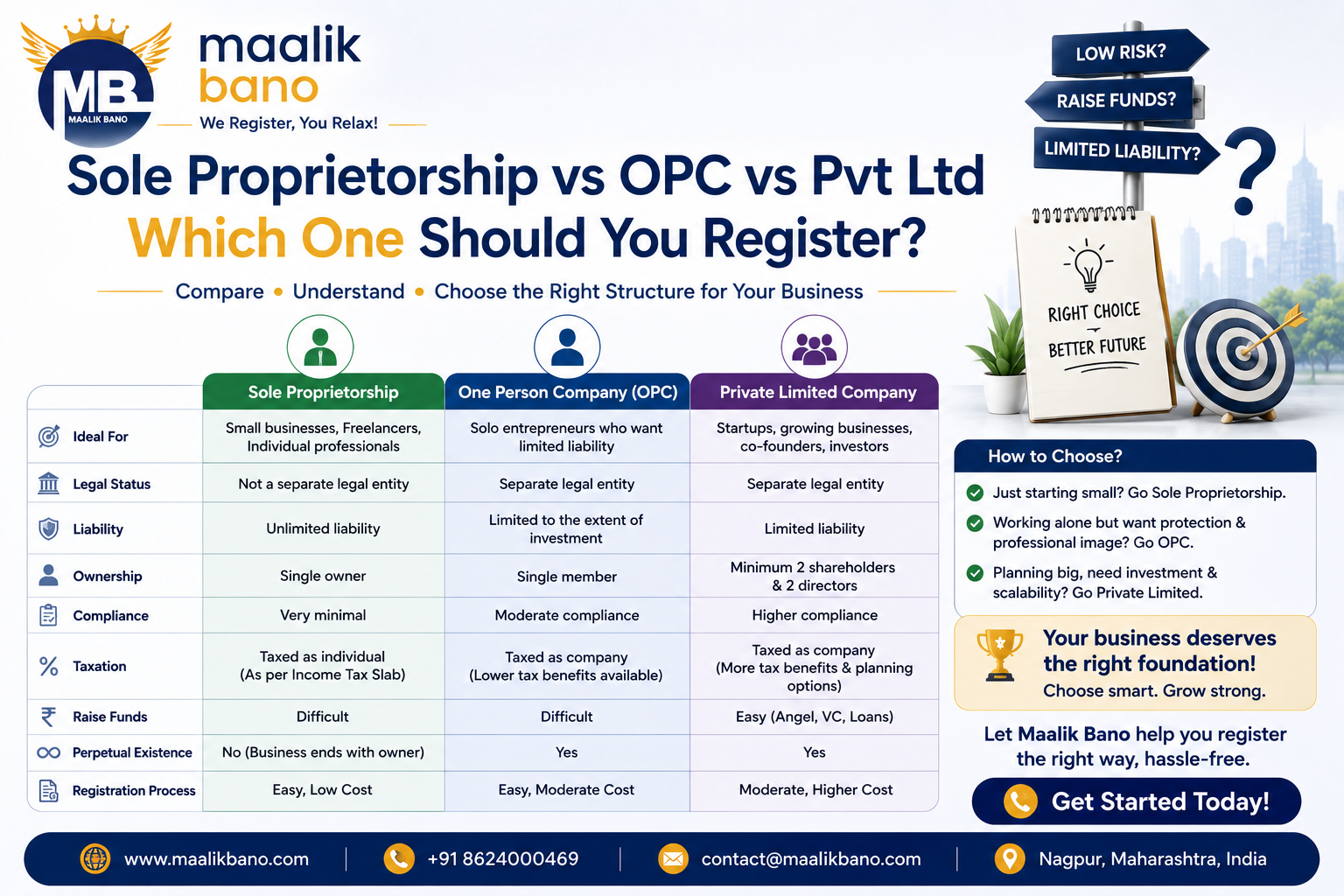
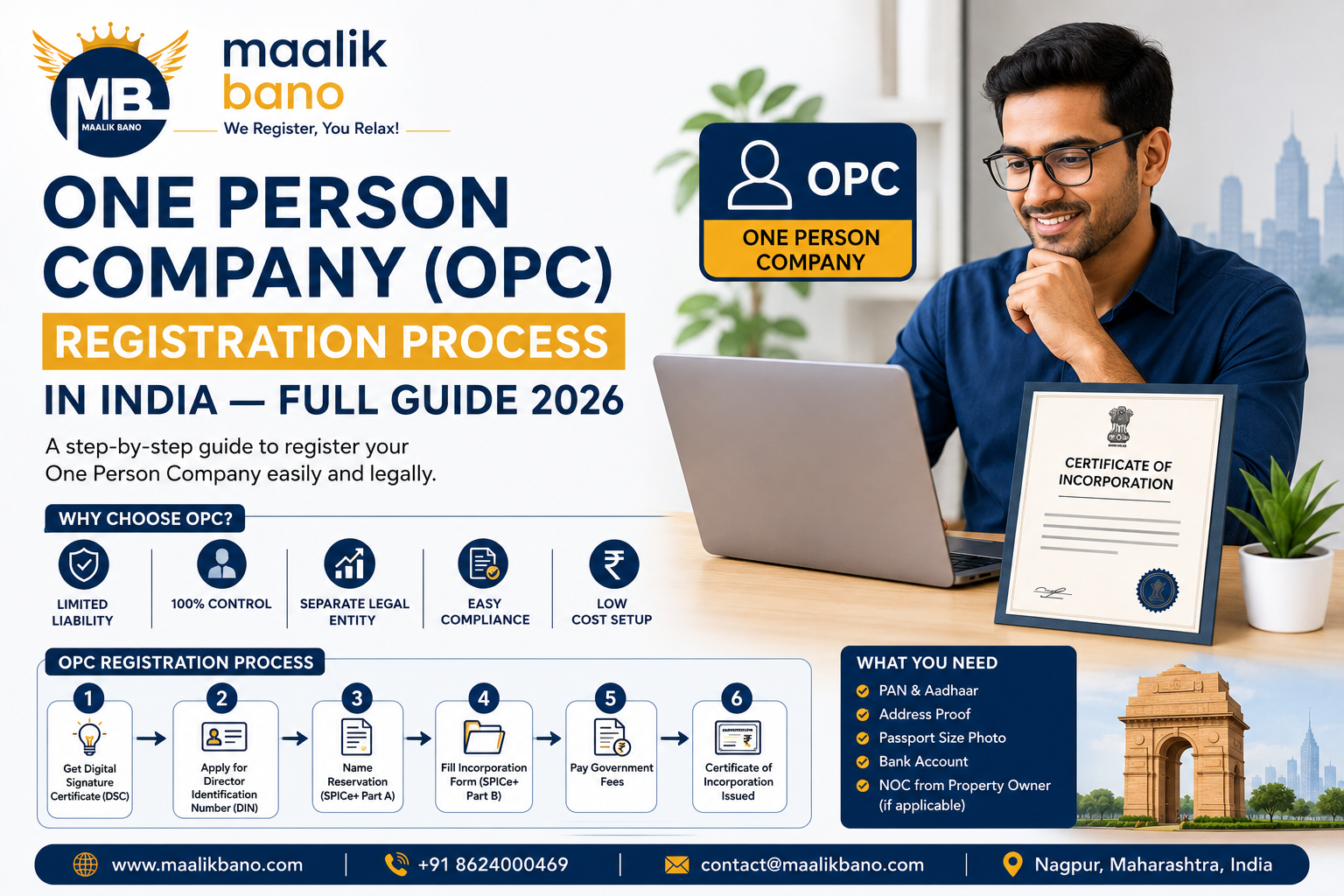
If you’re a solo founder who wants the legal protection of a company without bringing in a co-founder, a One Person Company (OPC) is likely the structure you’ve landed on. It’s been steadily gaining popularity since the 2021 amendments made it easier for solo entrepreneurs to register, convert, and grow without artificial restrictions.
This guide walks you through everything: eligibility, documents, the step-by-step SPICe+ filing process, timelines, costs, and what happens after incorporation — all updated for 2026.
What Is an OPC, Exactly?
An OPC is a company defined under Section 2(62) of the Companies Act, 2013, with only one person as its member. It’s incorporated as a private company under Section 3(1)(c), which means you get a separate legal identity, limited liability protection, and the ability to sign contracts, open bank accounts, and raise structured credit — all in the company’s name, not yours personally.
You’re the sole shareholder and, in most cases, the sole director too. The one non-negotiable requirement: you must appoint a nominee, who steps in only if something happens to you, so the company doesn’t simply cease to exist.
Who Is Eligible to Register an OPC?
- Only a natural person who is an Indian citizen can incorporate an OPC — NRIs and foreign nationals are not eligible.
- The person must be a resident of India, meaning they stayed in India for at least 120 days in the previous financial year (this was relaxed from the earlier 182-day requirement under the 2021 amendment).
- The same individual cannot incorporate more than one OPC at a time, and cannot act as a nominee in more than one OPC either.
- The nominee must also be an Indian citizen and resident, and their written consent (Form INC-3) is mandatory at the time of incorporation.
- Certain regulated activities — like banking, insurance, and Non-Banking Financial Investment activities — cannot be carried out through an OPC structure.
Documents Required for OPC Registration
For the sole member/director: – PAN card – Aadhaar card, passport, or driving licence (identity proof) – Recent bank statement, utility bill, or telephone bill (address proof, not older than 2 months) – Passport-size photograph – Digital Signature Certificate (DSC)
For the registered office: – Latest utility bill (electricity/water/gas, not older than 2 months) – Rent agreement + NOC from the landlord (if rented), or sale deed (if owned)
For the nominee: – PAN and address proof – Signed consent in Form INC-3
Company formation documents: – Memorandum of Association (MOA) – Articles of Association (AOA)
A word of caution echoed across nearly every filing guide: address proofs older than two months are one of the most common reasons applications get sent back for correction, so double-check dates before you upload anything.
Step-by-Step OPC Registration Process (2026)
Registration runs entirely online through the MCA V3 portal, using the integrated SPICe+ (INC-32) form. Here’s how it flows in practice:
Step 1: Obtain a Digital Signature Certificate (DSC) Every document you file needs to be digitally signed. Apply for a Class 3 individual DSC through a government-recognised certifying authority using your Aadhaar and PAN — this can typically be done within a day.
Step 2: Apply for Director Identification Number (DIN) If you don’t already have a DIN, it’s applied for directly within the SPICe+ Part B form itself — there’s no need for a separate application.
Step 3: Reserve Your Company Name — SPICe+ Part A Propose up to two names for approval via SPICe+ Part A. Your name must end with “(OPC) Private Limited” and shouldn’t clash with any existing registered company, LLP, or trademark. Approval typically takes 1–3 working days, and once reserved, you have 20 days to complete incorporation.
Step 4: Draft the MOA and AOA The Memorandum of Association defines your company’s objectives; the Articles of Association lay out its internal rules. These are prepared using MCA’s standard e-templates and must be consistent with the rest of your application.
Step 5: File SPICe+ Part B This is where the bulk of the incorporation happens — director and shareholder details, registered office address, and the nominee’s consent via Form INC-3, all bundled together. SPICe+ also integrates PAN, TAN, GST (if opted for), EPFO, ESIC, and bank account opening requests into the same filing, so you’re not running five separate applications.
Step 6: Pay Government Fees and Stamp Duty Fees depend on your authorized capital and the state of incorporation — more on this below.
Step 7: ROC Verification and Certificate of Incorporation Once the Registrar of Companies verifies your documents, you’ll receive your Certificate of Incorporation (CoI), which includes your Corporate Identity Number (CIN), PAN, and TAN. This is the moment your OPC legally exists.
Step 8: File INC-20A (Declaration for Commencement of Business) Don’t stop at the CoI. You must file INC-20A within 180 days of incorporation confirming that subscribed capital has been received. Missing this deadline attracts a ₹50,000 penalty and legally bars the company from commencing business.
Typical Timeline
|
Stage |
Time |
|---|---|
|
DSC issuance |
1 day |
|
Name reservation (SPICe+ Part A) |
1–3 working days |
|
SPICe+ Part B filing + ROC verification |
5–10 working days |
|
Total (with clean documents) |
7–15 working days |
OPC Registration Cost in 2026
Costs vary by authorized capital, state, and whether you use a professional service. Here’s a realistic breakdown:
|
Component |
Estimated Cost |
|---|---|
|
Government/SPICe+ filing fee |
₹0–₹2,000 (nil for authorized capital up to ₹15 lakh in most cases) |
|
DSC |
₹1,000–₹2,000 |
|
DIN (via SPICe+) |
Included / ~₹500 |
|
Stamp duty (state-dependent) |
Varies by state |
|
Professional/consultancy fees |
₹5,000–₹15,000 |
|
Total estimated cost |
₹6,000–₹20,000 |
If you’re just starting out, keeping your authorized capital modest (many founders start at ₹1 lakh) keeps your government fees close to zero and saves you from overpaying at the incorporation stage itself.
Life After Incorporation: What Compliance Looks Like
Registering the OPC is only the beginning. Once incorporated, you’re required to:
- File INC-20A within 180 days to declare commencement of business
- Conduct a statutory audit every year, regardless of turnover — this is mandatory from Year 1
- File Form AOC-4 (audited financial statements) — typically by 27 September
- File Form MGT-7A (annual return) — typically by 30 May
- Maintain proper books of account and comply with income tax filing (OPCs are taxed as domestic companies, generally at a concessional 22% rate under Section 115BAA, plus surcharge and cess)
- Register for GST, EPFO, and ESIC if applicable, based on turnover and employee headcount
Late filings for AOC-4 and MGT-7A attract a penalty of ₹100 per day, per form — which adds up fast if you let it slide.
When Does an OPC Need to Convert to a Pvt Ltd Company?
Earlier rules capped an OPC’s paid-up capital at ₹50 lakh and turnover at ₹2 crore, beyond which conversion to a Private Limited Company became mandatory. Recent amendments have relaxed several of these restrictions, giving OPCs more room to grow before conversion becomes necessary — but it’s worth checking the current thresholds with a professional before you scale aggressively, since the rules here have shifted more than once in the last few years.
Common Mistakes That Delay OPC Registration
Looking across dozens of registration guides and filing checklists, the same handful of errors keep showing up:
- Submitting address proofs older than two months
- Choosing a name that’s too similar to an existing company, LLP, or registered trademark
- Incomplete or inconsistent details between the MOA/AOA and the SPICe+ form
- Forgetting to file Form INC-3 (nominee consent) — it cannot be added after incorporation
- Missing the 180-day INC-20A deadline post-incorporation
Each of these is entirely avoidable with a careful first pass — which is exactly why most solo founders choose to have a professional review their filing before it goes to the ROC.
Should You Register the OPC Yourself or Get Help?
Technically, yes — you can walk through SPICe+ on the MCA portal on your own. But between DSC procurement, drafting a legally sound MOA/AOA, getting nominee consent right, and avoiding the small document errors that trigger rejections, most first-time founders find it faster and cheaper in the long run to have someone experienced handle it end to end.
This is where Maalik Bano comes in. Their team manages the entire Private Limited Company and OPC registration process — from DSC and name reservation to SPICe+ filing, MOA/AOA drafting, and follow-up compliance like GST, MCA, and income tax registration — with real-time updates so you’re never left guessing where your application stands. If you’re in Delhi, Mumbai, Pune, or Nagpur, you can also get a free expert consultation first to confirm whether an OPC is actually the right structure for you before you file anything.
Final Word
An OPC gives solo founders something a sole proprietorship can’t: a separate legal identity and limited liability, without needing a second person on paper. With the SPICe+ system, registration in 2026 is faster and more integrated than it’s ever been — but the process still rewards founders who get their documents right the first time. Whether you file it yourself or bring in expert help, know your eligibility, keep your paperwork current, and budget for the compliance that follows incorporation, not just the incorporation itself.