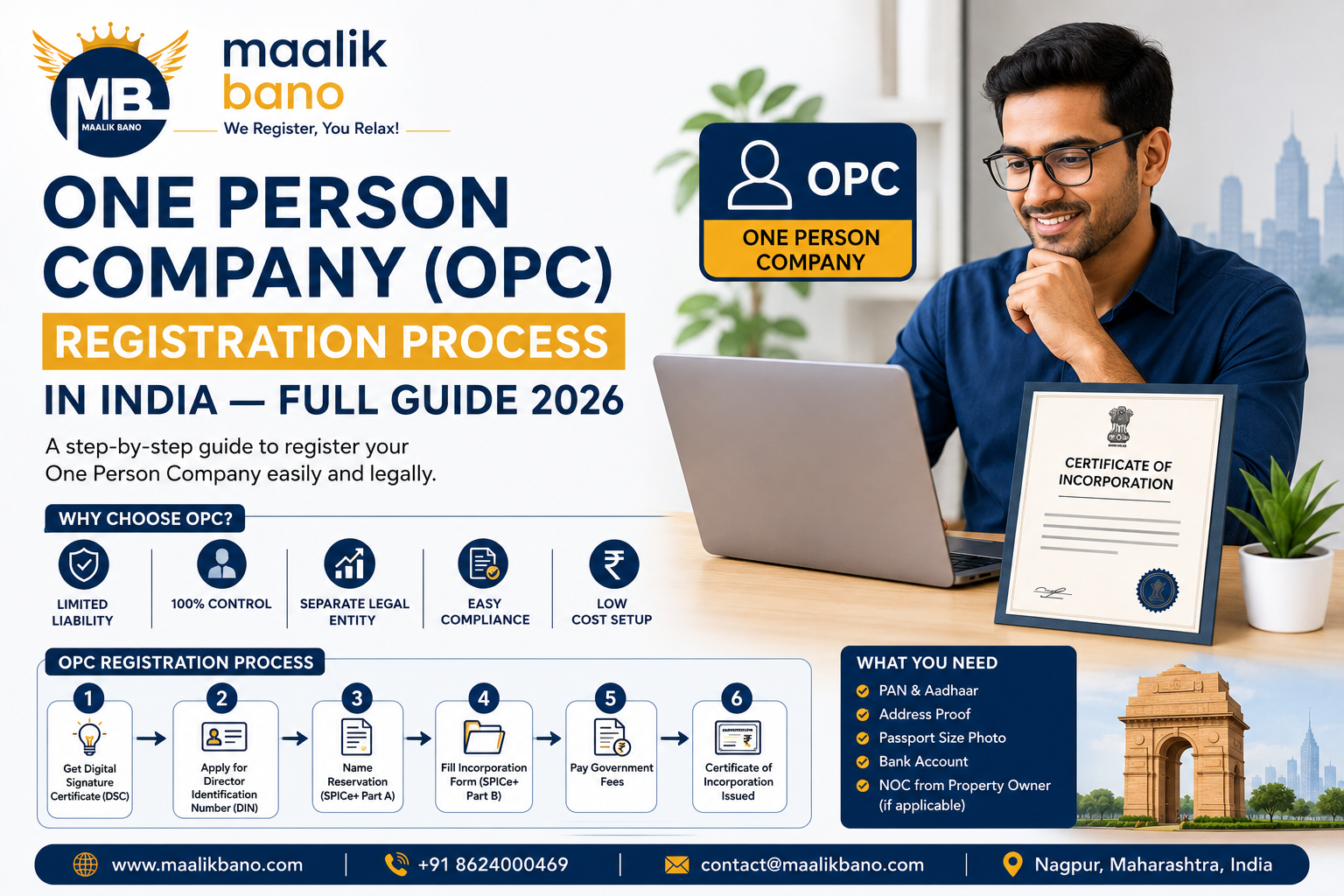
Here is something nobody tells you when you decide to register a company in India: the process itself is actually quite straightforward. The MCA has made it 100% online. You can do it from your laptop, at home, in your pyjamas if you like. The forms are integrated. The portal is functional. The government has genuinely tried to make this easy.
And yet, thousands of applications get delayed or rejected every year. Not because of complicated legal issues. Not because the Registrar of Companies has it in for first-time founders. But because someone uploaded a utility bill that was three months old instead of two. Or forgot to get a NOC from the property owner. Or their Aadhaar name says Rahul Kumar but their PAN says Rahul K. That one missing middle initial can hold up your entire incorporation.
We have seen it happen dozens of times at Maalik Bano. Founders who had great business ideas, committed co-founders, and even their first client lined up — stuck waiting three extra weeks because of a single document mismatch. This guide exists so that does not happen to you.
India registered over 185,000 new companies in FY 2023-24 (Ministry of Corporate Affairs). The country is at a remarkable moment for business. Opportunity is real. But so is the paperwork. Let us walk through every single thing you need — in the right order, with the right context — so you can get your Certificate of Incorporation and get on with building.
Step 1 — Pick Your Business Structure (This Shapes Everything Else)
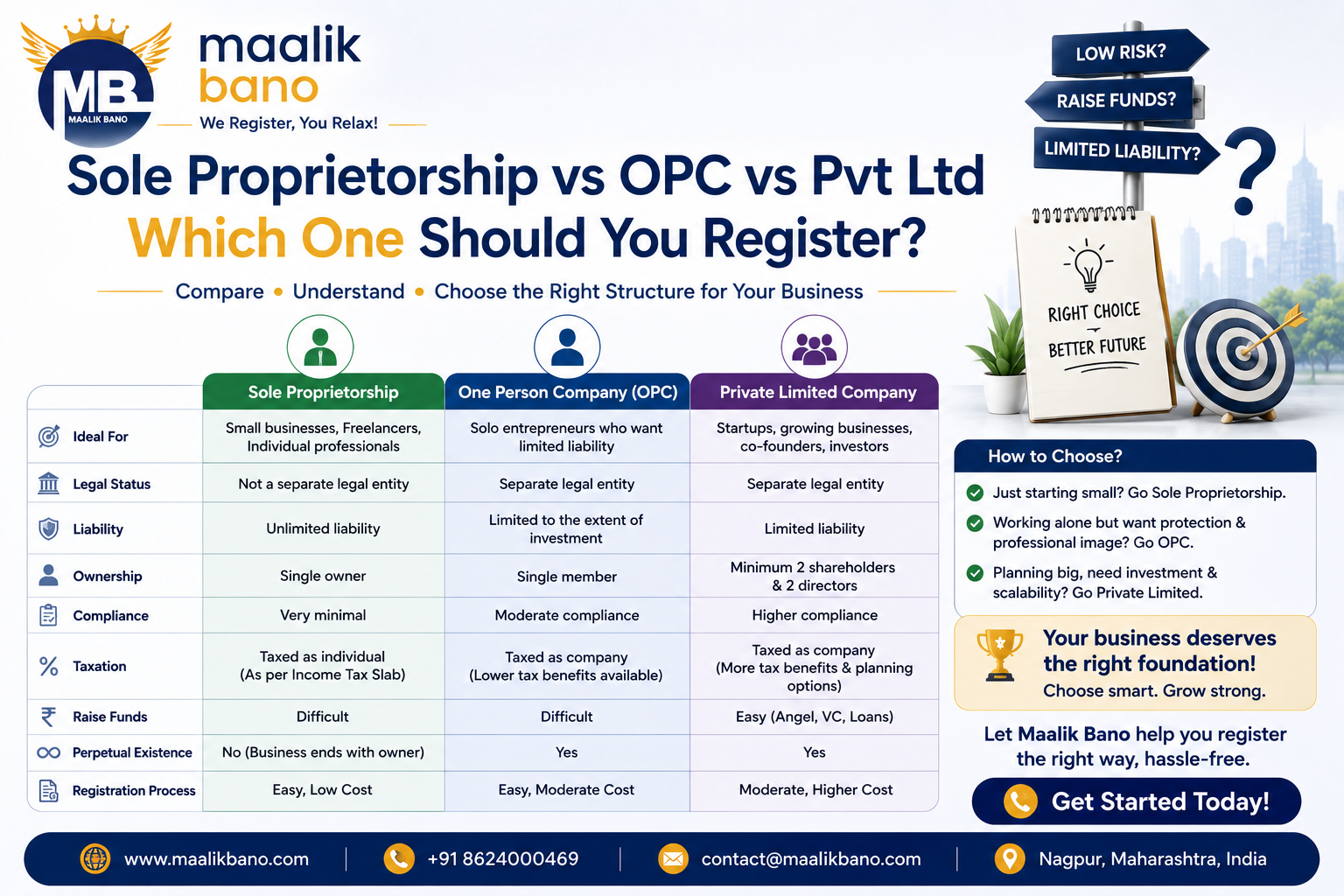
The first decision you make — your business structure — affects every document you will need, every form you will file, how you get taxed, how you bring in investors, and how complicated your annual compliance will be. Get this wrong and you will be spending money on a restructuring six months later. Get it right and everything flows naturally from here.
India offers five main structures for new businesses. Here is the honest breakdown:
|
Structure |
Best For |
Key Advantage |
Filing Form |
|
Private Limited (Pvt Ltd) |
Startups, VC-backed businesses |
Raises investment, scales well, high credibility |
SPICe+ |
|
One Person Company (OPC) |
Solo founders, freelancers going corporate |
Full control, limited liability, no partners needed |
SPICe+ |
|
LLP |
Consultants, professionals, service firms |
Flexible, lower compliance burden than Pvt Ltd |
FiLLiP |
|
Partnership Firm |
Small local businesses |
Simple setup, low cost |
Partnership Deed |
|
Sole Proprietorship |
Very small, single-person ops |
Easiest to start, no MCA filing required |
GST / Shops Act |
|
Maalik Bano honest take: If you are planning to raise funding, bring in co-founders, or want the business to outlive any single person, go Private Limited. If you are a solo operator who wants limited liability without a partner, OPC is quietly one of the best structures in India and very underused. If you are two professionals setting up a firm together and want flexible profit-sharing without heavy ROC compliance, LLP is your answer. Not sure? Our free 15-minute consultation at Maalik Bano will sort it out before you spend a rupee. |
Step 2 — The Document Checklist (The Part That Actually Trips People Up)
This is the section most founders skip or skim because they assume they already know what documents they need. Please do not do that. Read this carefully. The MCA is not forgiving of almost right documents.
2A. Personal Documents — Every Director and Shareholder Needs These
Whether you are the sole founder or one of ten shareholders, every single person involved in the company’s formation needs to submit their own set of documents. The MCA cross-checks everything. Inconsistencies between documents — even small ones like a name spelled differently on your PAN versus your Aadhaar — are an automatic flag.
Identity Proof
- PAN Card — Non-negotiable. Every Indian director and subscriber must have one. It is the basis for your DIN application and all future tax compliance. If your PAN does not exist yet, sort this first before anything else.
- Aadhaar Card — Required for identity verification and is directly linked to DIN processing on the MCA portal. Your Aadhaar mobile number must be active because OTP verification is involved.
- Passport-size Photograph — Recent, clear, white background. Sounds trivial. It is not. Blurry or coloured-background photos get flagged.
- Passport — Mandatory for foreign nationals and NRIs as primary identity proof. Must be apostilled (for Hague Convention countries) or attested by the Indian Embassy / Consulate. Self-attested foreign documents are rejected outright under MCA rules.
Address Proof — Any One of the Following
- Aadhaar Card (if not already submitted as identity proof)
- Voter ID
- Driving Licence
- Passport (if not used as identity proof)
- Bank Statement — critically, this must not be older than two months from your application date
- Utility bill (electricity, water, gas, broadband) — also not older than two months
|
The two-month rule catches a lot of people off-guard. You gather all your documents in January, feel organised and prepared, and then life gets busy. You finally sit down to file in March — and your November electricity bill is now four months old and invalid. At Maalik Bano, we track document expiry dates for every client and send reminders before anything goes stale. It sounds like a small thing until it is the reason your application gets sent back. |
2B. Director Identification Number (DIN)
Every director of an Indian company must hold a valid DIN — a unique identification number assigned by the MCA. The good news is that if you are incorporating a new company, you can apply for DINs for up to three directors directly within the SPICe+ form itself. You do not need a separate pre-registration step for new companies.
The important catch: if a proposed director already has a DIN from a previous company, that DIN must be active. Directors are required to complete DIR-3 KYC every year before 30 September. If the annual KYC was missed, the DIN gets deactivated — and a deactivated DIN will block your entire incorporation until it is reactivated. Check DIN status at the MCA portal before you do anything else.
2C. Digital Signature Certificate (DSC)
Because the entire incorporation process happens online, every proposed director needs a Class 2 (Sign) DSC — essentially an electronic signature that authenticates everything you submit on the MCA21 portal. Without a valid DSC, you cannot sign a single form.
DSCs are issued by government-certified certifying authorities like eMudhra, nCode, and Sify. Fees typically start from ₹2,500 per applicant and the process usually takes one to three working days. Plan for this early — many founders discover they need a DSC only after they have sat down at the MCA portal, and then lose two or three days waiting for it.
Step 3 — Registered Office Documents (The Most Frequently Missed Set)
Under Section 12 of the Companies Act 2013, your company must have a registered office address from the moment it is incorporated. This address appears on your Certificate of Incorporation, all government correspondence, MCA filings, and legal notices. You cannot change it easily later, so choose carefully.
And yet, this is the document set that trips up more applicants than any other. Here is exactly what you need:
- Utility Bill for the premises — electricity, gas, water, or broadband — in the name of the property owner, not older than two months. The bill must show the full address clearly.
- No Objection Certificate (NOC) — if the premises is owned by anyone other than the company itself (which it almost always is at incorporation stage), a written NOC signed by the property owner is mandatory. This is the single most missed document we encounter at Maalik Bano. Even if the property belongs to a director’s parent, spouse, or family member, you still need a signed NOC.
- Rent / Lease Agreement — if the premises is rented, submit a registered rent agreement along with the NOC from the landlord.
- Sale Deed / Property Documents — only required if the premises is owned outright by a company director at the time of filing.
What if you do not have a physical office yet? This is more common than you might think — especially for founders who are working from home or have a remote team. Virtual office addresses are accepted by MCA as registered office addresses for Indian companies. Several providers in metros and tier-2 cities offer this. Maalik Bano can connect you with compliant virtual office options so your incorporation does not get held up by a lease agreement you are still negotiating.
Step 4 — Understanding SPICe+ and What You Are Actually Filing
If you have been reading about company registration and kept seeing the term SPICe+ without fully understanding what it is, here is the plain-English explanation: it is a single, integrated web form on the MCA21 Version 3 portal that handles almost everything in one shot. Name reservation. DIN application. Incorporation. PAN. TAN. GST. EPFO. ESIC. Even a bank account request. All in one filing.
Before SPICe+, founders had to file a series of separate forms, wait between each one, and manage multiple back-and-forths with different government departments. SPICe+ collapsed that into a single workflow. For founders, this means less paperwork, fewer portals, and a much shorter timeline when done right.
SPICe+ Part A — Name Reservation
This is where you reserve your company’s name before incorporating. You can propose up to two name options. The MCA checks your proposed name against:
- Existing company and LLP names on the MCA database
- Trademark registry (to avoid conflicts with registered marks)
- The Emblems and Names (Prevention of Improper Use) Act, 1950
- MCA naming guidelines — no names that are too generic, misleading, or identical to existing registered names
Name rejections are common and frustrating. Our advice: be specific and distinctive. ‘India Tech Solutions Private Limited’ is almost certainly going to be rejected. ‘Vaibhav Precision Components Private Limited’ probably sails through. If your first choice comes back rejected, the clock resets. At Maalik Bano, we help clients shortlist three to four solid name options before filing so we always have a strong fallback.
SPICe+ Part B — The Incorporation Details
- Memorandum of Association (MoA) — filed via e-MoA (Form INC-33). This document defines your company’s objectives, its authorised capital, and its relationship with the outside world. Every significant business activity you ever want to pursue should appear in your MoA’s objects clause. Drafting this too narrowly will cause compliance headaches later.
- Articles of Association (AoA) — filed via e-AoA (Form INC-34). This is your company’s internal rulebook — how meetings are conducted, how shares are transferred, how directors are appointed. For most standard Pvt Ltd companies, a Table-F AoA (the MCA’s default template) is perfectly adequate.
- INC-9 — Declaration by first directors and subscribers. All directors and shareholders must sign this digitally using their DSC.
- DIR-2 — Each director’s formal consent to act as director of the company.
- Registered office proof documents (as described in Step 3).
AGILE-PRO-S — The Form Most Founders Do Not Know About
Filed simultaneously with SPICe+, AGILE-PRO-S is one of the most underused tools in the Indian company registration process. Most founders do not even know it exists — and as a result, they spend weeks after incorporation running around to register for GST, EPFO, and a bank account separately. AGILE-PRO-S handles all of this in the same filing:
- GSTIN — your GST registration number
- EPFO registration — mandatory once you hire employees
- ESIC — Employee State Insurance registration
- Bank account opening request with select partner banks
- Professional Tax registration (for Maharashtra, Karnataka, and other applicable states)
- Shops and Establishments Act registration
|
At Maalik Bano, we always file AGILE-PRO-S alongside SPICe+ for every client. The few extra fields it requires are completely worth the weeks of follow-up work it saves you post-incorporation. If your registration consultant is not filing AGILE-PRO-S as standard practice, that is worth a conversation. |
Step 5 — What the Timeline Actually Looks Like in 2026
Let us be honest about timelines. You will see a lot of websites claiming company registration in India takes ‘just 3 days’ or ‘within 24 hours.’ That is almost never true for a first-time founder with fresh documents, and promises like that are usually there to attract clicks, not to set realistic expectations.
Here is what a realistic, well-prepared incorporation looks like:
|
Stage |
What Actually Happens |
Realistic Time |
|
DSC Procurement |
Applied online via eMudhra / nCode; video verification required |
1–3 working days |
|
Name Reservation (RUN / SPICe+ Part A) |
MCA reviews name uniqueness and compliance |
1–3 working days |
|
SPICe+ + AGILE-PRO-S Filing |
All forms, declarations, and DIN applications submitted |
1–2 working days |
|
MCA Processing & ROC Review |
Registrar reviews documents; may raise queries |
3–7 working days |
|
Certificate of Incorporation |
CIN allotted; your company legally exists |
Same day as ROC approval |
|
PAN & TAN Allotment |
Auto-issued via AGILE-PRO-S integration |
1–2 days after CoI |
Total realistic timeline: 7–15 working days with clean documents. The ROC may raise queries (called ‘resubmission’) if anything is unclear — which adds another 5–10 days per round. At Maalik Bano, our average is under 10 working days because we check everything before filing, not after.
|
2026 fee update: The MCA incorporation fee is currently waived for companies with authorised capital up to ₹15 lakh — which means ROC fees are zero for most small company registrations. You will still pay state-specific stamp duty on your MoA and AoA (varies by state), plus DSC costs. Always verify the current fee schedule at mca.gov.in before budgeting. |
Step 6 — After You Get Your Certificate of Incorporation
Getting your Certificate of Incorporation is a genuinely exciting moment. Your company is legally real. It exists. But here is what a lot of founders do not realise: you have a fairly tight clock on several mandatory post-incorporation steps, and missing them carries real penalties under the Companies Act 2013.
Here is what needs to happen — and how fast:
Within 30 Days of Incorporation
- Open a corporate current bank account — use your Certificate of Incorporation and PAN. You cannot receive share capital or operate business finances until this is done.
- Appoint a Statutory Auditor — this is not optional. File Form ADT-1 to formally appoint your auditor within 30 days. Failure to appoint attracts penalties under Section 139 of the Companies Act.
Within 180 Days of Incorporation
- File INC-20A — this is the Commencement of Business declaration. You must file this before your company can start operations, receive any deposits, or exercise any borrowing powers. It requires proof that each subscriber has paid their share of the subscribed capital into the company’s bank account. Forgetting INC-20A is one of the most expensive mistakes a new company can make — the penalty is ₹50,000 for the company and ₹1,000 per day for each officer in default.
Within 30 Days of Crossing Turnover Threshold
- GST Registration — mandatory once your annual turnover crosses ₹20 lakh (₹10 lakh for special category states). If you are selling across state lines, selling online, or in certain notified sectors, GST registration may be required from Day 1 regardless of turnover. Maalik Bano handles GST registration as part of our incorporation package.
Ongoing Annual Compliance
- DIR-3 KYC — all directors must complete this annually by 30 September. Miss it and your DIN gets deactivated.
- Annual ROC filings — Form MGT-7 (Annual Return) and Form AOC-4 (Financial Statements). Due within 60 days of AGM for MGT-7 and 30 days for AOC-4.
- Income Tax Return — due by 31 October for companies (audited financials required).
- Board Meetings — first board meeting must be held within 30 days of incorporation. At least four board meetings per financial year thereafter.
- MSME / Udyam Registration — technically optional but highly recommended. Opens up priority sector lending, government scheme eligibility, and protection against delayed payments.
The Full Checklist — Print This and Tick It Off
|
Use this as your master reference. Every item here corresponds to a detailed explanation above. If anything is unclear, call Maalik Bano on +91 8624000469 — our team picks up. |
Structure & Pre-Filing
- Business structure decided (Pvt Ltd / OPC / LLP / etc.)
- Minimum 2 directors confirmed (1 for OPC)
- At least 1 director must be Indian resident (residing in India for 182+ days in the previous calendar year)
- Proposed company name(s) shortlisted — at least 2-3 options ready
Personal Documents — Each Director & Shareholder
- PAN Card — self-attested copy
- Aadhaar Card — self-attested copy; mobile number linked and active
- Passport-size photograph — recent, white background
- Address proof — bank statement or utility bill, not older than 2 months
- For foreign nationals: passport (apostilled / Embassy attested) + foreign address proof (apostilled)
Digital Requirements
- Class 2 DSC procured for every director — from eMudhra, nCode, or Sify
- DIN — applied for within SPICe+ (or verified as active if pre-existing)
- DIR-3 KYC completed for all existing DIN holders (check status at mca.gov.in)
Registered Office
- Office address finalised — physical or virtual
- Utility bill for premises — in owner’s name, not older than 2 months
- NOC from property owner — signed, dated, on plain paper
- Rent agreement — if rented premises
Incorporation Forms
- SPICe+ Part A — name reservation filed
- SPICe+ Part B — incorporation details, DIN, MoA (INC-33), AoA (INC-34), INC-9, DIR-2
- AGILE-PRO-S — filed alongside SPICe+ for GST, EPFO, ESIC, bank account
Post-Incorporation (Checklist Continues After CoI)
- Corporate bank account opened — within 30 days
- Statutory Auditor appointed via ADT-1 — within 30 days
- INC-20A filed — within 180 days
- GST registration applied — as applicable
- First Board Meeting held — within 30 days of incorporation
- Share capital paid up and receipts documented
|
Want someone to just handle this for you? That is exactly what Maalik Bano does. We prepare your complete document set, review everything for MCA compliance before filing, submit SPICe+ and AGILE-PRO-S, follow up with the ROC, and give you real-time updates until your Certificate of Incorporation lands. No chasing. No surprises. No hidden fees. Hundreds of companies registered across India — from Nagpur to Delhi to Mumbai. maalikbano.com | +91 8624000469 | contact@maalikbano.com |
Frequently Asked Questions
How long does company registration take in India in 2026?
With all documents complete and accurate, a Private Limited Company or OPC typically gets incorporated in 7–15 working days via the MCA21 portal. Delays almost always trace back to document mismatches, a name conflict at the reservation stage, or the ROC raising a resubmission query. Every round of resubmission adds 5–10 working days.
What is the cost of registering a company in India?
The MCA incorporation fee is currently waived for companies with authorised capital up to ₹15 lakh — which covers the vast majority of new incorporations. You will still pay state stamp duty on MoA and AoA (varies by state), DSC costs (from ₹2,500 per director), and professional fees for document preparation and filing. At Maalik Bano, we offer transparent all-inclusive pricing with no hidden charges — contact us for a quote specific to your structure.
Can a single person register a company in India?
Absolutely. The One Person Company (OPC) structure was introduced precisely for this purpose. A single Indian resident can incorporate with full limited liability, no co-founder required. You need one director, one nominee (who steps in if the director is incapacitated or dies), and one shareholder — all of which can be the same person. Maalik Bano has registered numerous OPCs for solo founders across India.
What is SPICe+ and why does it matter?
SPICe+ (Simplified Proforma for Incorporating Company Electronically Plus) is the single integrated web form on the MCA21 Version 3 portal through which all private limited companies and OPCs are incorporated in India as of 2026. It handles name reservation, DIN application, incorporation filings, PAN, TAN, and — via the linked AGILE-PRO-S form — GST, EPFO, ESIC, and bank account opening. It replaced the older multi-form process and has significantly reduced the paperwork burden for founders.
Is GST registration required at the time of company registration?
Not automatically. GST registration becomes mandatory when your annual turnover crosses ₹20 lakh (₹10 lakh for special category states), or if you are selling across state lines, operating on an e-commerce platform, or in certain notified sectors where turnover limits do not apply. However, because you can apply for GST via AGILE-PRO-S at the time of incorporation, we recommend doing it then rather than scrambling to register later when you are already busy running the business.
What happens if I miss filing INC-20A?
This is more serious than most founders realise. If INC-20A is not filed within 180 days of incorporation, your company cannot legally start business operations or exercise any borrowing powers. The penalty is ₹50,000 for the company and ₹1,000 per day for each defaulting officer. The MCA can also initiate action to remove the company’s name from the register. Set a calendar reminder the day your CoI arrives — 180 days goes faster than you expect.