So you’ve decided to start a business in India. Congratulations — that’s the easy part. The next decision, the one that quietly shapes your taxes, your liability, your ability to raise funding, and even how seriously clients and vendors treat you, is choosing the right legal structure.
Most first-time founders get stuck between three options: Sole Proprietorship, One Person Company (OPC), and Private Limited Company (Pvt Ltd). Each one solves a different problem, and picking the wrong one can cost you time, money, and a fair bit of paperwork later when you have to convert.
Let’s break each one down in plain language, compare them side by side, and help you figure out which one fits where you actually are in your business journey — not where you hope to be someday.
What Is a Sole Proprietorship?
A sole proprietorship is the simplest business structure that exists in India. There’s no legal separation between you and your business — you are the business. There’s no mandatory central registration process; you typically just need a GST registration (once your turnover crosses the threshold), a Shop & Establishment license, or Udyam/MSME registration depending on your trade.
Best suited for: freelancers, small local shops, single-person service providers, and anyone testing a business idea before committing further.
Pros: – Fastest and cheapest to start — often within days – Minimal compliance and paperwork – Full control, no partners to consult – All profits belong to you, taxed as personal income
Cons: – Unlimited personal liability — if the business owes money, your personal assets (house, savings, car) are on the line – No separate legal identity, so it ends when you do – Harder to raise funding — banks may lend, but investors generally won’t touch it – Lower credibility with larger clients and vendors who prefer working with registered companies
What Is an OPC (One Person Company)?
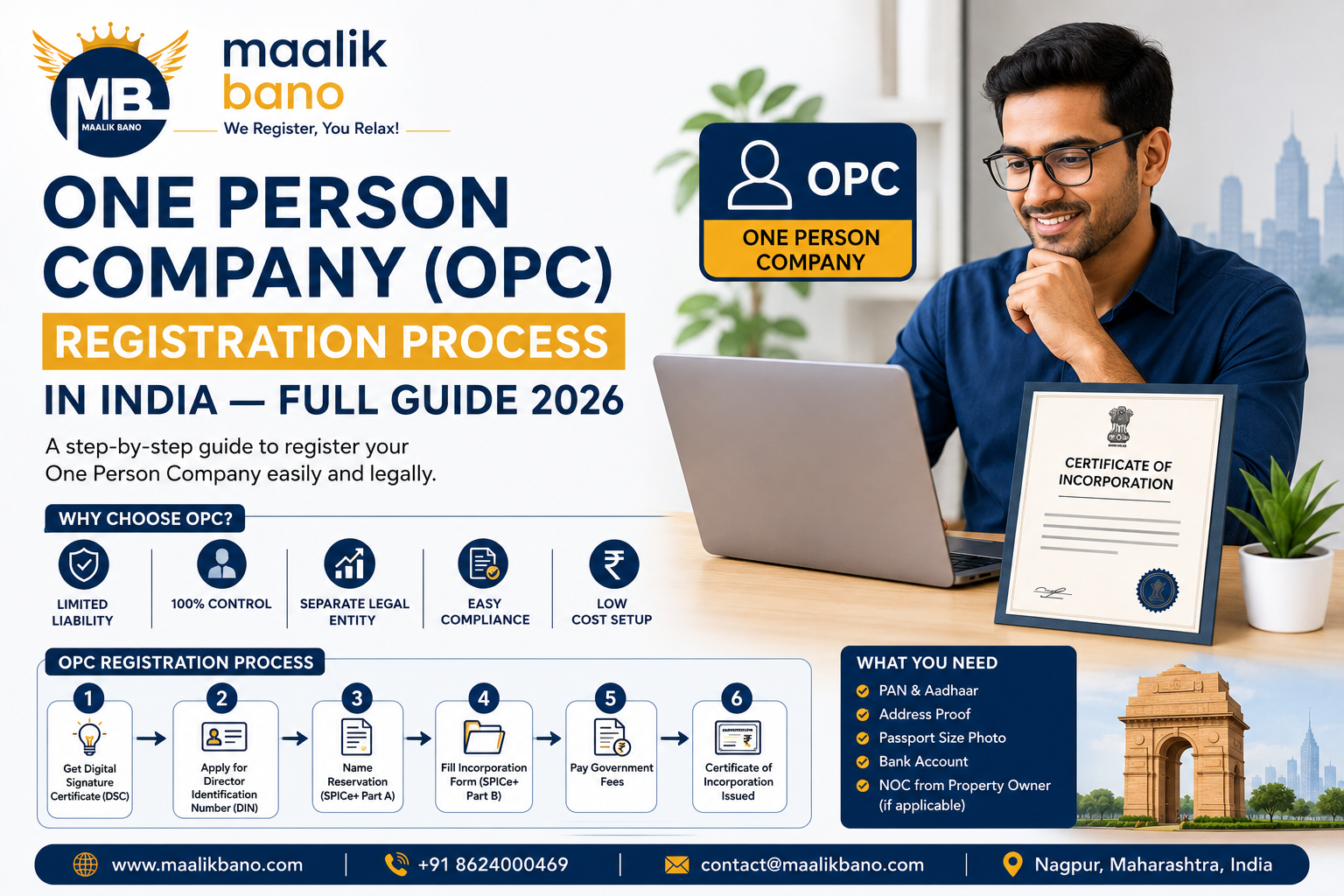
Introduced under the Companies Act, 2013, an OPC was designed specifically for solo entrepreneurs who want the protection of a company without needing a co-founder. You remain the sole shareholder and director, but you’re required to appoint a nominee director who steps in only if something happens to you — ensuring the business doesn’t just disappear.
Best suited for: solo consultants, designers, content creators, and single-founder businesses that want legal protection and a more professional identity while staying lean.
Pros: – Limited liability — your personal assets are protected – Separate legal identity, so the company can own assets, sign contracts, and open bank accounts in its own name – Perpetual succession — the business continues via the nominee even if you’re unavailable – Fewer compliance requirements than a Pvt Ltd company (no AGM needed, for instance) – Can be taxed as a domestic company at a concessional rate under Section 115BAA
Cons: – Higher setup and maintenance cost than a proprietorship – Requires MCA registration and ongoing ROC filings – Only one person can be shareholder and director — you can’t bring in co-founders without converting first – Investors generally still prefer Pvt Ltd, so if you’re planning to raise institutional funding soon, an OPC may just be a temporary stop
What Is a Private Limited Company (Pvt Ltd)?
A Pvt Ltd company is the structure most startups eventually land on — and for good reason. It requires a minimum of two shareholders and two directors, offers limited liability, has a separate legal identity, and is built to scale. If you’re planning to raise money from angel investors or VCs, take on co-founders, or issue ESOPs to employees, this is generally the structure that makes all of that possible.
Best suited for: startups with growth ambitions, businesses with co-founders or partners, and anyone planning to raise external investment.
Pros: – Strongest credibility with investors, banks, and larger clients – Limited liability protection for all shareholders – Can issue equity shares to raise funding – Easier to add or remove shareholders and directors as the company grows
Cons: – More compliance: mandatory audits, annual returns, board meetings, and ROC filings under the Companies Act, 2013 – Higher setup and ongoing costs compared to OPC or proprietorship – Restrictions on transferring shares, and it cannot invite the public to subscribe to shares
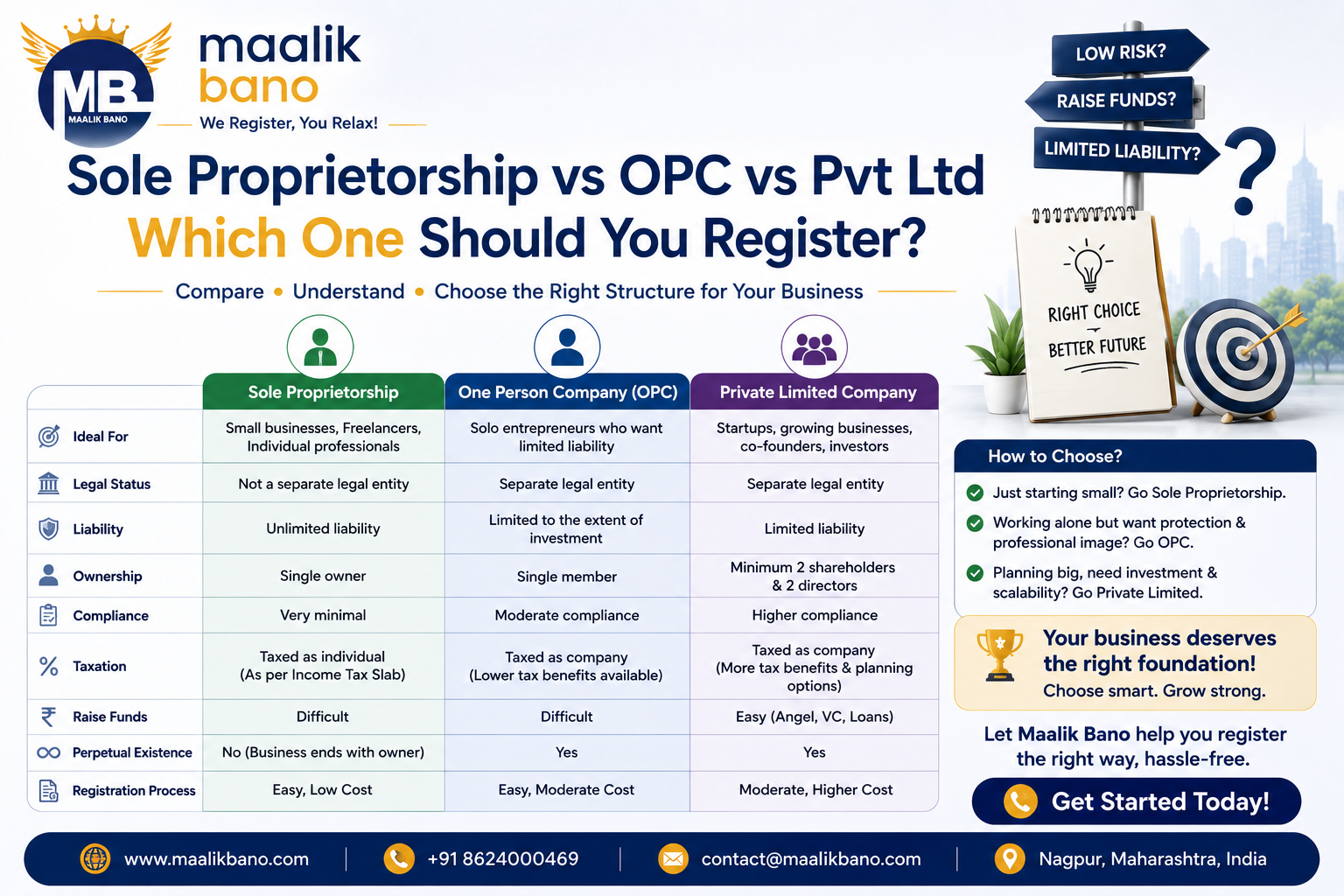
Sole Proprietorship vs OPC vs Pvt Ltd — Quick Comparison
|
Factor |
Sole Proprietorship |
OPC |
Pvt Ltd |
|---|---|---|---|
|
Owners required |
1 |
1 |
Minimum 2 |
|
Legal identity |
Same as owner |
Separate |
Separate |
|
Liability |
Unlimited |
Limited |
Limited |
|
Registration authority |
GST/Shop Act (no central body) |
MCA (ROC) |
MCA (ROC) |
|
Compliance burden |
Minimal |
Moderate |
High |
|
Fundraising from investors |
Very difficult |
Difficult |
Easiest |
|
Ideal for |
Testing an idea, small local business |
Solo founder wanting protection & credibility |
Startups planning to scale or raise funds |
So, Which One Should You Actually Register?
There’s no universally “best” structure — only the one that’s right for where you are right now. A useful way to think about it:
- Just testing the waters or running a small, low-risk local business? Start with a Sole Proprietorship. It’s fast, cheap, and lets you validate your idea without heavy commitment.
- You’re a solo founder, but you’re serious about it — you want your personal assets protected, and you want to look credible to clients and banks? An OPC is often the sweet spot.
- You already have a co-founder, or you know you’ll need outside investment within the next year or two? Go straight for a Pvt Ltd company. Starting as an OPC and converting later works, but it adds an extra layer of time, paperwork, and professional fees you could skip by starting right.
One more thing worth remembering: none of these decisions are permanent traps. You can convert a sole proprietorship into an OPC or Pvt Ltd later, and an OPC into a Pvt Ltd as well. But conversions involve transferring assets, liabilities, and sometimes contracts — which is more work than getting it right the first time.
A Quick Look at What’s Out There (Competitor Content Analysis)
If you search “Sole Proprietorship vs OPC vs Pvt Ltd” right now, most of the ranking content comes from company registration consultancies and fintech blogs — think FlexiLoans, RegisterKaro, IndiaFilings, Finguru, and Cashfree. A few patterns stand out across that content:
- Most articles lean heavily on comparison tables and FAQ sections, since that’s what ranks well and matches how people actually skim this kind of content.
- Several pieces use a persona-based approach — “Ramesh runs a small store,” “Riya earns ₹40 lakhs consulting” — to make abstract compliance rules feel concrete. It works, so we’ve kept that spirit here while staying original.
- A recurring gap: most of these articles are written by the registration firms selling the service, so they’re thorough on legal definitions but light on genuinely warm, plain-English guidance for someone who’s never registered a business before. That’s the space this article aims to fill.
- Almost every top-ranking piece ends with a soft CTA nudging the reader toward “expert help” for the actual registration — because on paper, this decision looks simple, but in practice, things like nominee director eligibility, DIN/DSC requirements, and MOA/AOA drafting trip people up.
Getting the Paperwork Right
Reading about these structures is one thing — actually filing the SPICe+ forms, getting your Digital Signature Certificate, reserving a company name, and drafting your MOA and AOA correctly is a different challenge altogether. A single mismatched detail can mean rejection and delays.
This is exactly where a guided registration partner earns its keep. Maalik Bano specializes in making company registration in India fast, affordable, and genuinely transparent — whether you’re registering a Private Limited Company, setting up an OPC, or just want expert consultation before you commit to a structure. Their process is refreshingly simple: fill out a form, get a free expert consultation on which structure actually fits your business, hand over your documents, and let their team handle the ROC filings, MCA compliance, and GST registration end to end — with real-time updates so you’re never left wondering what’s happening with your application.
If you’re based in Delhi, Mumbai, Pune, or Nagpur and want registration support that doesn’t disappear after you’ve paid the fee, it’s worth getting an expert consultation before you file anything.
Final Thoughts
Choosing between Sole Proprietorship, OPC, and Pvt Ltd isn’t just a legal formality — it’s a decision that shapes how you grow, how protected you are, and how the world perceives your business. Think about where you’ll realistically be in the next two to three years, not just what’s easiest today. And when in doubt, a quick conversation with a registration expert can save you months of course-correction down the line.