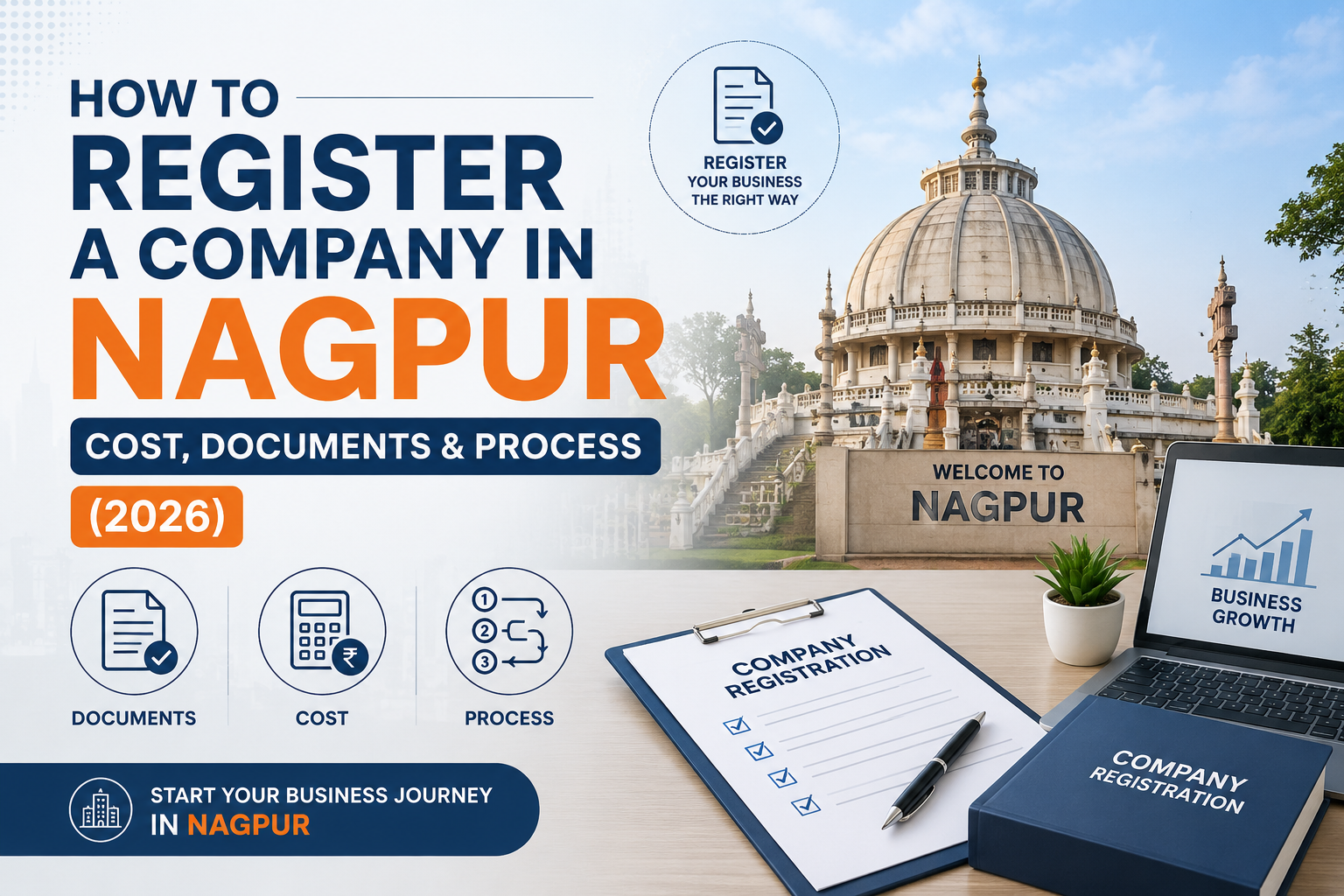
Nagpur has quietly become one of central India’s most active business hubs, from logistics and trading firms taking advantage of its location at the country’s geographic center to a growing wave of tech and services startups. If you’re planning to formally register a business here in 2026, this guide walks you through exactly what it costs, what documents you’ll need, and how the process actually works, step by step.
Why Register a Company in Nagpur?
Before getting into the process, it’s worth understanding why registration matters in the first place. An unregistered business, where you operate informally, offers no legal protection. If something goes wrong, your personal assets, such as your house or savings, can be at risk.
A registered entity, whether it’s a Private Limited Company, LLP, or One Person Company (OPC), gives you:
- Limited liability: Your personal assets stay separate from business debts.
- Credibility: Banks, investors, and larger clients generally take registered entities more seriously.
- Access to funding: VCs and institutional lenders generally won’t fund unregistered businesses.
- Tax structuring benefits: Depending on the entity type you choose.
Nagpur-based entrepreneurs also benefit from Maharashtra’s relatively straightforward stamp duty framework and a growing local ecosystem of professionals, including CAs, CSs, and consultants, who can guide them through the process. This makes Nagpur a relatively convenient place to register a business in India.
Which Business Structure Should You Choose?
This is the first and most important decision. Here’s a quick comparison:
Structure | Best For | Min. People | Liability | Compliance Burden |
|---|---|---|---|---|
Private Limited Company | Startups planning to raise funding or scale | 2 directors/shareholders | Limited | High |
One Person Company (OPC) | Solo founders wanting a formal structure | 1 (+1 nominee) | Limited | Medium |
LLP | Professional services, partnerships | 2 partners | Limited | Medium |
Sole Proprietorship | Small, local, low-risk businesses | 1 | Unlimited | Low |
If you’re unsure which structure best fits your situation, consider getting a quick consultation before filing. Choosing the wrong structure early on can lead to costly conversions later.
Documents Required for Company Registration in Nagpur
Regardless of the structure you choose, most of the paperwork overlaps. Here’s what you’ll typically need to have ready:
For Directors/Partners
- PAN card (mandatory, and the name must match exactly across all documents)
- Aadhaar card
- Passport-size photographs
- Address proof (bank statement, electricity bill, or telephone bill not older than 2 months)
For the Registered Office
- Latest electricity/utility bill (not older than 2 months)
- Rent agreement (if the premises are rented)
- No Objection Certificate (NOC) from the property owner
- Property ownership documents (if self-owned)
Additional Requirements
- Digital Signature Certificate (DSC): Required for all directors, as the entire process is completed online.
- Director Identification Number (DIN): For new companies, DIN is applied for through the SPICe+ form.
- Draft Memorandum of Association (MOA) and Articles of Association (AOA): Required for Private Limited Companies and OPCs.
A common mistake here: mismatched names or addresses across documents. Even a small spelling inconsistency between your PAN and Aadhaar can get your application sent back by the ROC, adding a week or more to your timeline.
Step-by-Step Company Registration Process in Nagpur
The entire process runs through the Ministry of Corporate Affairs (MCA) portal and is 100% digital — you don’t need to visit any government office in person.
Step 1: Obtain Digital Signature Certificates (DSC)
Every proposed director needs a Class 3 DSC to sign forms electronically. This usually takes 1–2 days through a government-approved certifying agency.
Step 2: Reserve Your Company Name
Using the SPICe+ Part A form, you propose a unique company name. It can’t be identical or deceptively similar to any existing registered company or trademark. Approval typically takes 1–2 business days.
Step 3: Apply for DIN
For new companies, the Director Identification Number is applied for directly within the SPICe+ form — no separate application needed.
Step 4: File SPICe+ Part B
This is the core incorporation form. It combines company incorporation, PAN, TAN, and, for most structures, EPFO and ESIC registration into a single filing, along with your MOA, AOA, and supporting documents.
Step 5: Pay Government Fees and Stamp Duty
Fees are paid online and vary based on your authorized capital and company type (more on this below).
Step 6: Receive Your Certificate of Incorporation
Once the Registrar of Companies (ROC) verifies everything, you’ll receive your Certificate of Incorporation (COI), along with your company’s PAN and TAN. This usually takes 7–15 working days from submission, provided your documents are accurate and complete.
Step 7: Post-Incorporation Steps
Open a current bank account in the company’s name, and apply for GST registration if your turnover or business type requires it.
Cost of Company Registration in Nagpur (2026)
This is where most guides get vague. Here’s a realistic breakdown of what you’re actually paying for:
Cost Component | Approximate Range |
|---|---|
Digital Signature Certificate (per director) | ₹500 – ₹1,500 |
Director Identification Number (per director) | ~₹500 |
Name Reservation Fee | ₹1,000 – ₹2,000 |
ROC Filing Fees | Varies by authorized capital |
Stamp Duty | ₹500 – ₹15,000+ (depends on capital and structure) |
Professional / Consultant Fees | ₹3,000 – ₹12,000+ |
Total cost by structure (all-inclusive estimates):
- Sole Proprietorship: Under ₹5,000 (plus GST registration if needed)
- One Person Company (OPC): ₹4,000 – ₹12,000
- LLP: ₹5,000 – ₹10,000, depending on partner capital contribution
- Private Limited Company: Starting around ₹8,000 – ₹15,000+, depending on authorized capital and the professional package you choose
Common Mistakes That Delay Registration
- Document mismatches: Inconsistent names or addresses across PAN, Aadhaar, and utility bills.
- Name rejections: Proposing a name that is too similar to an existing company or trademark.
- Incomplete NOC: Missing or improperly signed No Objection Certificate for rented premises.
- Outdated utility bills: Bills older than 2 months are typically rejected.
- Choosing the wrong structure: This can lead to costly conversions down the line.
Final Thoughts
Company registration in Nagpur is more straightforward than most first-time founders expect — the entire process is digital, timelines are predictable (7–15 working days), and Maharashtra’s regulatory environment is fairly entrepreneur-friendly. The part that actually determines whether things go smoothly is document accuracy and picking the right structure from day one.
If you’d rather not navigate SPICe+ forms, MOA drafting, and ROC back-and-forth on your own, Maalik Bano handles the entire registration process, covering everything from choosing the right structure to filing and obtaining your Certificate of Incorporation, with transparent, all-inclusive pricing and no hidden charges. Whether you’re registering a Private Limited Company, LLP, or OPC, their team manages the paperwork so you can focus on running your business.
Ready to get started? Get a free consultation with Maalik Bano and have your company registered in Nagpur without the usual back-and-forth.