
Starting a business in India requires selecting the right legal structure. The type of company registration you choose determines your liability, taxation, compliance requirements, ownership structure, and funding opportunities.
India offers several types of business entities under the Companies Act, 2013, and other relevant laws. Each structure is designed to suit different types of businesses — from solo entrepreneurs to large corporations.
In this guide, we will explore the different types of company registration in India, their key features, advantages, and which type may be suitable for your business.
Why Choosing the Right Business Structure Matters
Selecting the correct company structure is important because it affects:
- Legal liability of owners
- Tax obligations
- Ability to raise funding
- Compliance requirements
- Ownership and management control
- Business credibility
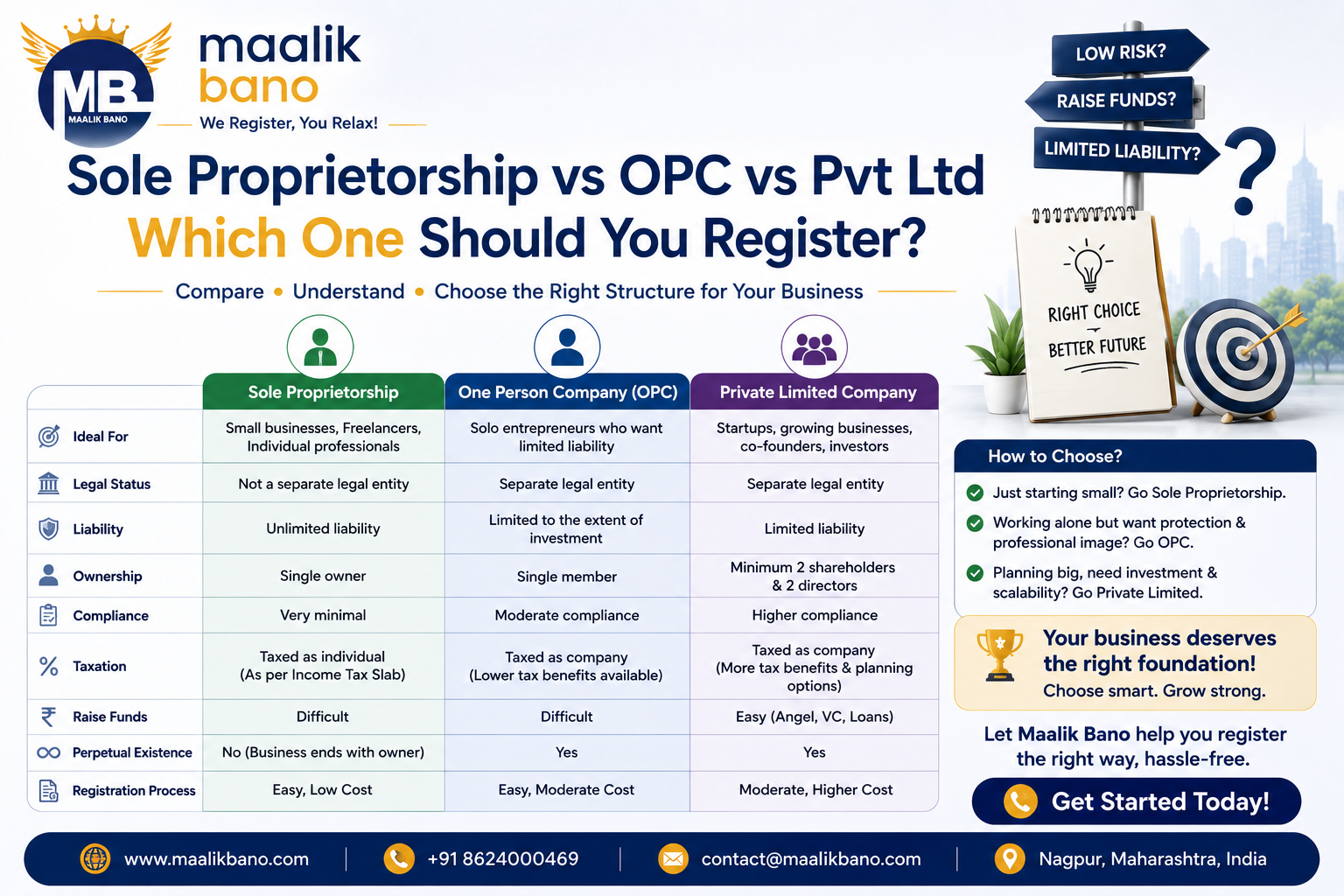
For example, startups looking for investors often prefer Private Limited Companies in India, while freelancers or small traders may operate as Sole Proprietorships.
Major Types of Company Registration in India
Below are the most common types of business structures in India.
1. Private Limited Company (Pvt Ltd)
A Private Limited Company is one of the most popular business structures in India, especially for startups and growing businesses.
It is registered under the Companies Act, 2013, and offers limited liability protection to its shareholders.
Key Features
- Minimum 2 directors
- Minimum 2 shareholders
- Maximum 200 shareholders
- Separate legal entity
- Limited liability protection
Advantages
- Easy to raise investment
- High business credibility
- Limited liability for owners
- Perpetual succession
Best For
- Startups
- Technology companies
- Growing businesses seeking funding
2. Public Limited Company
A Public Limited Company is suitable for large businesses that want to raise capital from the public through shares.
These companies can list their shares on stock exchanges.
Key Features
- Minimum 3 directors
- Minimum 7 shareholders
- No maximum limit on shareholders
- Can issue shares to the public
Advantages
- Easy capital raising
- Greater credibility
- Business expansion opportunities
Best For
- Large enterprises
- Businesses planning IPO
- Companies seeking large investments
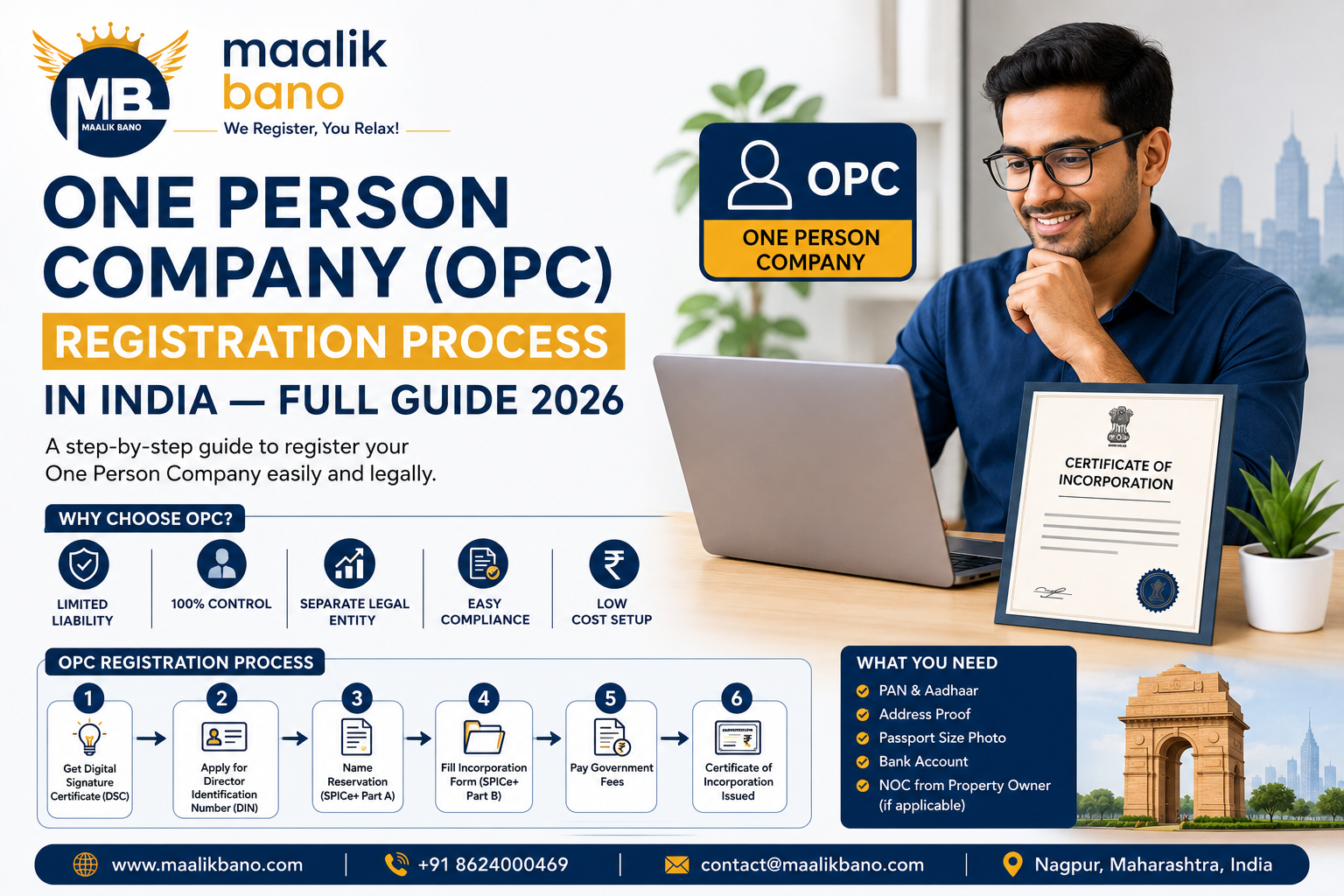
3. One Person Company (OPC)
A One Person Company (OPC) allows a single entrepreneur to start a company with limited liability protection.
It combines the benefits of a sole proprietorship and a private limited company.
Key Features
- Only 1 owner
- 1 director required
- Limited liability protection
- Separate legal identity
Advantages
- Full control by the owner
- Limited liability
- Easy management
Best For
- Solo entrepreneurs
- Consultants
- Small business owners
4. Limited Liability Partnership (LLP)
An LLP (Limited Liability Partnership) combines features of both a partnership and a company.
Partners have limited liability, and the compliance requirements are lower than a company.
Key Features
- Minimum 2 partners
- No maximum limit
- Separate legal entity
- Limited liability for partners
Advantages
- Lower compliance cost
- Flexible management
- Limited liability
Best For
- Professional firms
- Consulting businesses
- Small partnerships
5. Partnership Firm
A Partnership Firm is one of the simplest business structures where two or more individuals run a business together.
It is governed by the Indian Partnership Act, 1932.
Key Features
- Minimum 2 partners
- Maximum 20 partners
- Shared profits and responsibilities
- Partnership agreement required
Advantages
- Easy to start
- Less compliance
- Shared responsibilities
Best For
- Small businesses
- Family businesses
- Trading businesses
6. Sole Proprietorship
A Sole Proprietorship is the simplest form of business in India, where a single individual owns and manages the business.
Key Features
- Owned by one person
- No separate legal identity
- Simple registration process
- Minimal compliance
Advantages
- Easy to start
- Full control
- Low cost of operation
Best For
- Freelancers
- Local shops
- Small traders
7. Section 8 Company (Non-Profit Organization)
A Section 8 Company is formed for charitable or non-profit purposes.
These companies promote:
- Education
- Charity
- Research
- Social welfare
- Environmental protection
Key Features
- Non-profit objective
- Profits must be used for charitable purposes
- Requires a government license
Best For
- NGOs
- Charitable organizations
- Social enterprises
Comparison of Company Registration Types
|
Business Type |
Owners |
Liability |
Compliane |
Best For |
|
Sole Proprietorship |
1 |
Unlimited |
Very Low |
Small businesses |
|
Partnership Firm |
2+ |
Unlimited |
Low |
Traditional businesses |
|
LLP |
2+ |
Limited |
Moderate |
Professional services |
|
OPC |
1 |
Limited |
Moderate |
Solo entrepreneurs |
|
Private Limited |
2+ |
Limited |
High |
Startups |
|
Public Limited |
7+ |
Limited |
Very High |
Large companies |
|
Section 8 Company |
2+ |
Limited |
Moderate |
NGOs |
How to Register a Company in India
The company registration process generally involves the following steps:
- Choose a business structure
- Obtain Digital Signature Certificate (DSC)
- Apply for Director Identification Number (DIN)
- Reserve the company name through the MCA portal
- File incorporation documents
- Obtain Certificate of Incorporation
Because the process involves several legal and documentation requirements, many entrepreneurs prefer professional assistance.
You can simplify the entire registration process with expert support from MaalikBano.
Why Choose Professional Help for Company Registration?
Registering a company involves legal procedures, compliance requirements, and documentation. Professional services ensure:
- Faster company registration
- Correct documentation
- Legal compliance
- Expert business guidance
- Reduced chances of rejection
Platforms like MaalikBano provide expert support to help entrepreneurs start their business smoothly and legally in India.
Conclusion
India offers multiple company registration options to suit different business needs. From sole proprietorships and partnerships to private limited companies and LLPs, each structure has its own benefits and compliance requirements.
Choosing the right business structure is a crucial step toward building a successful and legally compliant business.
If you are planning to start your company and need professional assistance, visit https://maalikbano.com/ to get expert help with company registration, compliance, and business setup services.