Starting a business in India gives you several legal structures to choose from, and a Limited Liability Partnership (LLP) is one of the fastest-growing options among professionals, consultants, and small business owners. As of 2026, over 3 lakh LLPs are active in India, and that number is climbing steadily.
Why? Because an LLP gives you the best of both worlds: the flexible management of a traditional partnership and the limited liability protection of a company, all at a lower compliance cost.
In this complete guide, you will learn everything about LLP registration in India, including what an LLP is, who should choose it, the step-by-step registration process on the MCA portal, documents required, fees involved, and what you need to do after incorporation.
What Is an LLP (Limited Liability Partnership)?
A Limited Liability Partnership is a body corporate registered under the Limited Liability Partnership Act, 2008. It is a separate legal entity, meaning the LLP itself can own assets, enter contracts, sue, and be sued, independent of its partners.
The key distinction from a traditional partnership is limited liability protection. Each partner’s personal assets are protected from the LLP’s debts and obligations, except in cases of personal fraud or wrongful acts.
Key features of an LLP:
- Separate legal identity from its partners
- Partners’ personal liability is limited to their agreed contribution
- Perpetual succession, the LLP continues even if partners change.
- No minimum capital requirement
- Lower compliance burden compared to a Private Limited Company
- Taxed as a partnership firm (30% flat tax rate)
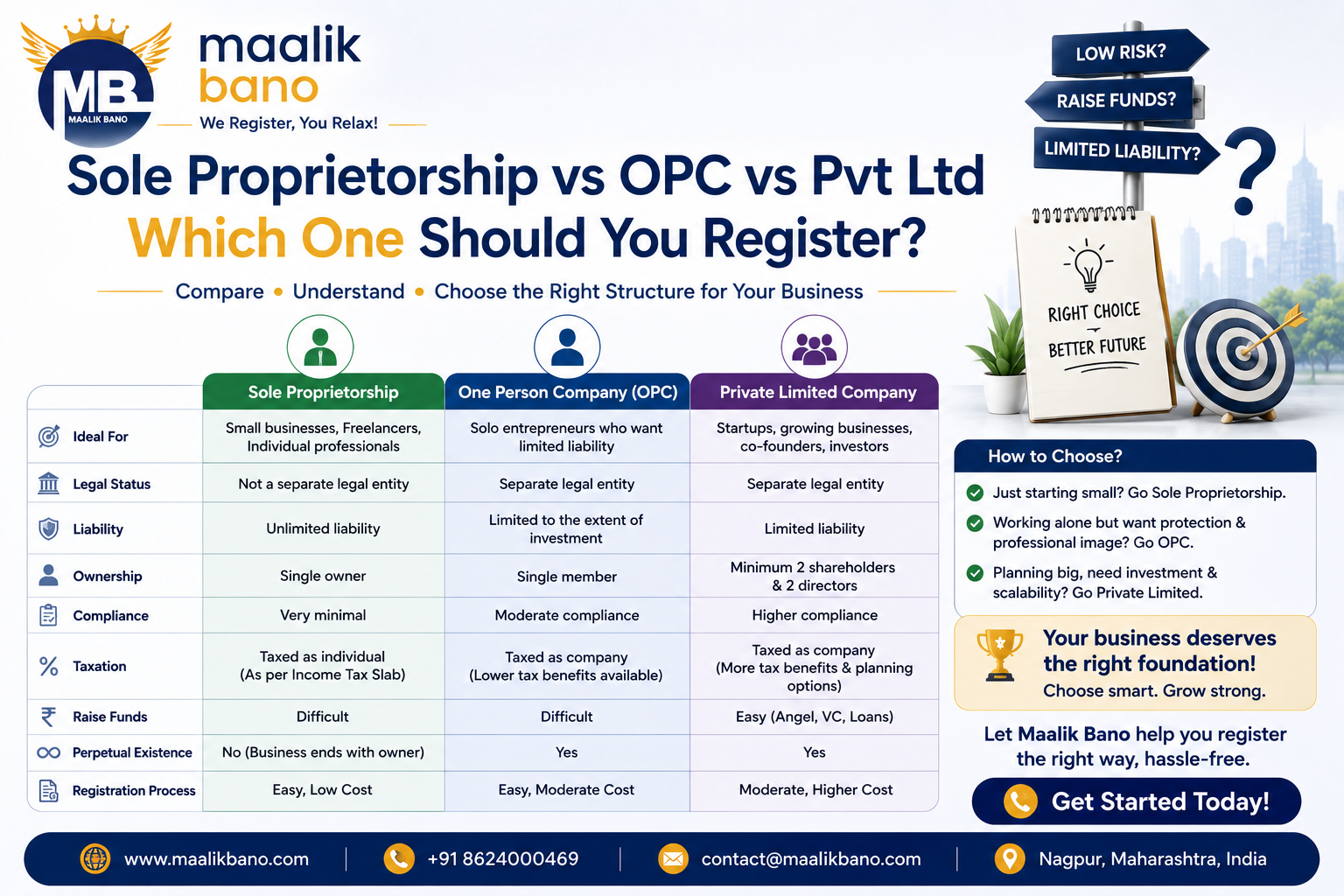
LLP vs Private Limited Company: Which Is Right for You?
This is the most common question entrepreneurs ask before registering. Here is a direct comparison:
|
Feature |
LLP |
Private Limited Company |
|
Minimum partners/directors |
2 partners |
2 directors, 2 shareholders |
|
Limited liability |
Yes |
Yes |
|
Separate legal entity |
Yes |
Yes |
|
Minimum capital |
None |
None |
|
Compliance burden |
Lower |
Higher |
|
Tax rate |
30% flat |
22–25% |
|
Equity fundraising (VC/Angel) |
Not possible |
Possible |
|
ESOPs for employees |
Not possible |
Possible |
|
Annual ROC filings |
2 forms |
Multiple forms |
|
Ideal for |
Professionals, consultants, service firms |
Startups seeking investment |
Choose an LLP if you run a service-based business such as a law firm, accounting practice, consulting agency, IT services, or design studio, where you are not looking for institutional funding in the near future.
Choose a Private Limited Company if you are building a startup that will raise angel or venture capital funding. Investors in India strongly prefer the Pvt Ltd structure because it allows equity issuance, ESOPs, and cleaner governance.
At MaalikBano, we specialize in Private Limited Company Registration across India. If you are a founder planning to raise investment, our team handles the complete Pvt Ltd incorporation process fast, transparent, and affordable. Get a free consultation today.
Who Can Register an LLP in India?
Before you begin the registration process, make sure your business meets the eligibility requirements under the LLP Act, 2008.
Eligibility criteria for LLP registration:
- Minimum 2 partners – can be individuals or corporate bodies. There is no upper limit on the number of partners.
- Minimum 2 designated partners – they must be individuals and are responsible for all regulatory compliance and filings.
- Residency requirement – at least one designated partner must have been resident in India for a minimum of 182 days in the previous financial year.
- Age requirement – all partners and designated partners must be at least 18 years old.
- No undischarged insolvent – no partner should be declared insolvent by a court of law.
Foreign nationals and NRIs can also be partners in an Indian LLP, but at least one designated partner must be a resident Indian.
Documents Required for LLP Registration in India
Getting your documents in order before you start saves time and reduces the risk of rejection. Here is a complete checklist.
For partners and designated partners:
- PAN card – mandatory for all Indian nationals
- Aadhaar card – for identity verification and e-KYC (mandatory from 2026)
- Passport-size photograph (recent, white background)
- Identity proof – Aadhaar, passport, or voter ID
- Address proof – bank statement, utility bill, or rental agreement (not older than 2 months)
- Passport – mandatory for NRIs and foreign nationals (notarized and apostilled if applicable)
For the registered office:
- Utility bill – electricity bill, gas bill, or telephone bill (not older than 2 months)
- Rent agreement – if the premises are rented
- NOC from owner – No Objection Certificate from the property owner
- Property ownership proof — if self-owned
LLP-specific documents:
- Consent to act as Designated Partner – Form 9 declaration
- Subscriber sheet – details of each partner and their capital contribution
- LLP Agreement draft – required for filing Form 3 (within 30 days of incorporation)
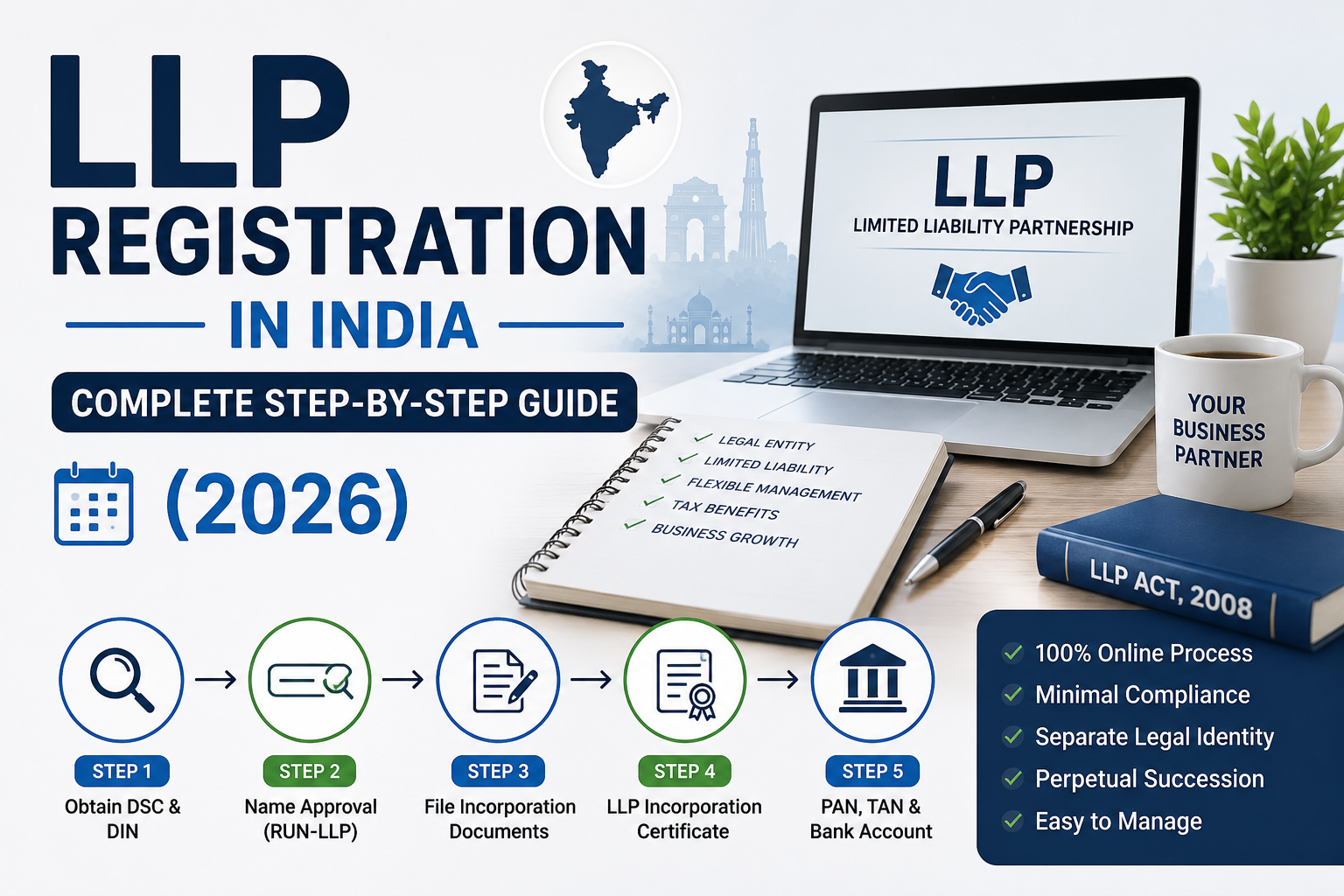
Step-by-Step LLP Registration Process in India (2026)
The entire LLP registration process is done online through the MCA V3 portal (mca.gov.in). In 2026, MCA has upgraded this portal to enable complete digital processing, real-time status tracking, and mandatory e-KYC via Aadhaar and PAN.
Here are the six steps to register your LLP:
Step 1: Obtain Digital Signature Certificate (DSC)
All designated partners must obtain a Class 3 Digital Signature Certificate (DSC) before filing any documents on the MCA portal. The DSC serves as your legally valid electronic signature.
How to get a DSC:
- Apply through a government-licensed Certifying Authority (CA) such as eMudhra, Sify, nCode, or NSDL.
- Submit your PAN card, Aadhaar card, passport-size photograph, and a valid email ID.
- DSC is issued within 1–2 working days.
- Cost: approximately ₹1,000–₹1,500 per DSC.
Important for 2026: MCA now mandates e-KYC verification using Aadhaar OTP at the time of DSC issuance. Ensure your Aadhaar is linked to your mobile number before applying.
Step 2: Apply for Designated Partner Identification Number (DPIN)
A Designated Partner Identification Number (DPIN) is a unique ID issued to every designated partner of an LLP. It is equivalent to the DIN (Director Identification Number) used in companies.
Good news: In 2026, you do not need to apply for DPIN separately. The DPIN for up to 2 designated partners is allotted automatically along with the Certificate of Incorporation when you file the FiLLiP form in Step 4. If a designated partner already has a DIN from a previous directorship, that number is used.
Step 3: Reserve Your LLP Name (RUN-LLP)
Before incorporating, you need to reserve a unique name for your LLP using the RUN-LLP (Reserve Unique Name – Limited Liability Partnership) web service on the MCA portal.
Rules for choosing an LLP name:
- Must end with “LLP” or “Limited Liability Partnership”
- Must not be identical or similar to any existing company, LLP, or registered trademark
- Must reflect the business activity of the LLP
- Cannot use restricted words (like “National,” “Bank,” “Insurance”) without prior approval
How to apply:
- Log in to the MCA V3 portal
- Navigate to the LLP services section and select RUN-LLP
- Propose up to 2 names (with justification)
- Pay the government fee of ₹200
Name approval typically takes 2–3 working days. The approved name is reserved for 3 months, within which you must complete incorporation.
Pro tip: Before submitting, always check name availability on the MCA portal AND the IP India trademark registry. A name that conflicts with a registered trademark will be rejected.
Step 4: File the FiLLiP Form (Core Incorporation Step)
The FiLLiP (Form for Incorporation of Limited Liability Partnership) is the central step in LLP registration. It is an integrated online form that combines multiple applications in one submission.
What FiLLiP covers:
- Proposed LLP name (if not already reserved via RUN-LLP)
- Business activity and registered office address
- Details of all partners and their capital contributions
- DPIN application for up to 2 designated partners (if not already held)
- PAN and TAN application for the LLP
Documents to attach:
- ID and address proof of all partners
- Registered office proof (utility bill + rent agreement/NOC)
- Subscriber sheet
- Consent of designated partners (Form 9)
Fees: MCA charges a nominal fee based on the LLP’s total capital contribution — typically ₹500 for contributions up to ₹1 lakh, scaling up with higher contributions.
The FiLLiP form must be digitally signed by all designated partners using their DSC and certified by a practising Chartered Accountant, Company Secretary, or Cost Accountant.
After successful verification, the Registrar of Companies (RoC) issues the Certificate of Incorporation (COI) along with the LLPIN (LLP Identification Number), PAN, TAN, and DPIN. This usually takes 5–7 working days from submission.
Step 5: File the LLP Agreement (Form 3)
The LLP Agreement is the foundational document that governs the relationship between partners — rights, duties, profit-sharing ratios, decision-making process, and exit terms.
Under Section 23 of the LLP Act, 2008, the LLP Agreement must be:
- Executed on stamp paper (stamp duty varies by state, typically ₹500–₹2,000)
- Filed with MCA via Form 3 within 30 days of incorporation
What the LLP Agreement must cover:
- Name and registered address of the LLP
- Nature of business
- Capital contribution of each partner
- Profit and loss sharing ratio
- Rights and duties of designated partners
- Procedure for admission and exit of partners
- Dispute resolution mechanism
Do not skip this step. If Form 3 is not filed within 30 days, the LLP is treated as if it has no agreement, and default rules under the LLP Act apply, which may not suit your business arrangements. Late filing also attracts penalties.
Step 6: Post-Incorporation Setup
Once your Certificate of Incorporation is in hand, complete these essential steps before starting operations:
- Open a current bank account – in the LLP’s name, using the COI, PAN card, and LLP Agreement
- Apply for GST registration – mandatory if annual turnover exceeds ₹40 lakh (₹20 lakh for services in most states) or if your LLP is involved in interstate trade
- Register for MSME / Udyam – optional but recommended for government scheme access and easier credit
- Set up accounting records – maintain books of accounts from the date of incorporation
- Get professional liability insurance – recommended for professional service LLPs
LLP Registration Fees in India (2026)
Here is a transparent breakdown of what LLP registration costs in 2026:
|
Fee Component |
Approximate Cost |
|
DSC (per designated partner) |
₹1,000–₹1,500 |
|
RUN-LLP name reservation |
₹200 |
|
FiLLiP government filing fee |
₹500–₹2,000 (based on capital) |
|
Stamp duty on LLP Agreement |
₹500–₹2,000 (varies by state) |
|
Form 3 filing fee |
₹50 |
|
Professional/consultant fees |
₹3,000–₹8,000 |
|
Total (estimate) |
₹5,000–₹15,000 |
This is significantly lower than Private Limited Company registration, which can cost ₹8,000–₹20,000 depending on the service provider and state.
Timeline for LLP Registration
With all documents in order and accurate submissions, LLP registration in India typically completes within 10–15 working days:
|
Step |
Time Required |
|
DSC procurement |
1–2 working days |
|
Name reservation (RUN-LLP) |
2–3 working days |
|
FiLLiP processing by MCA |
5–7 working days |
|
Form 3 (LLP Agreement) filing |
Within 30 days of COI |
NRIs or foreign nationals may require additional time (5–10 extra days) for notarization and apostille of documents.
Annual Compliance for LLPs in India
Registration is just the beginning. To keep your LLP legally active, you must file the following every year — even if your LLP has zero turnover:
|
Compliance |
Form |
Due Date |
Penalty for Late Filing |
|
Annual Return |
Form 11 |
30 May (every year) |
₹100 per day |
|
Statement of Accounts & Solvency |
Form 8 |
30 October (every year) |
₹100 per day |
|
Income Tax Return |
ITR-5 |
31 July (non-audit) / 31 October (audit) |
As per IT Act |
Statutory Audit is mandatory if:
- Annual turnover exceeds ₹40 lakh, OR
- Capital contribution exceeds ₹25 lakh
Annual compliance costs for a small LLP typically range from ₹12,000 to ₹30,000 per year through a professional firm.
Common Mistakes to Avoid During LLP Registration
Based on what we see across applications, here are the most frequent errors that delay LLP incorporation:
- Incorrect or mismatched name on documents – the name on your PAN card, Aadhaar, and address proof must match exactly.
- Outdated address proof – utility bills older than 2 months are rejected. Always use the most recent one.
- Choosing a name without checking trademarks – MCA will reject names that conflict with registered trademarks on the IP India portal.
- Not filing Form 3 within 30 days – many founders forget this after receiving the COI. Missing this deadline leads to penalties and operational complications.
- Wrong stamp duty amount – stamp duty on the LLP Agreement varies by state. Paying the wrong amount causes rejection. Check your state’s stamp act before printing.
- Aadhaar not linked to mobile – e-KYC via Aadhaar OTP is mandatory in 2026. If your Aadhaar is not linked to your mobile number, DSC procurement will fail.
Frequently Asked Questions About LLP Registration
Can a single person register an LLP?
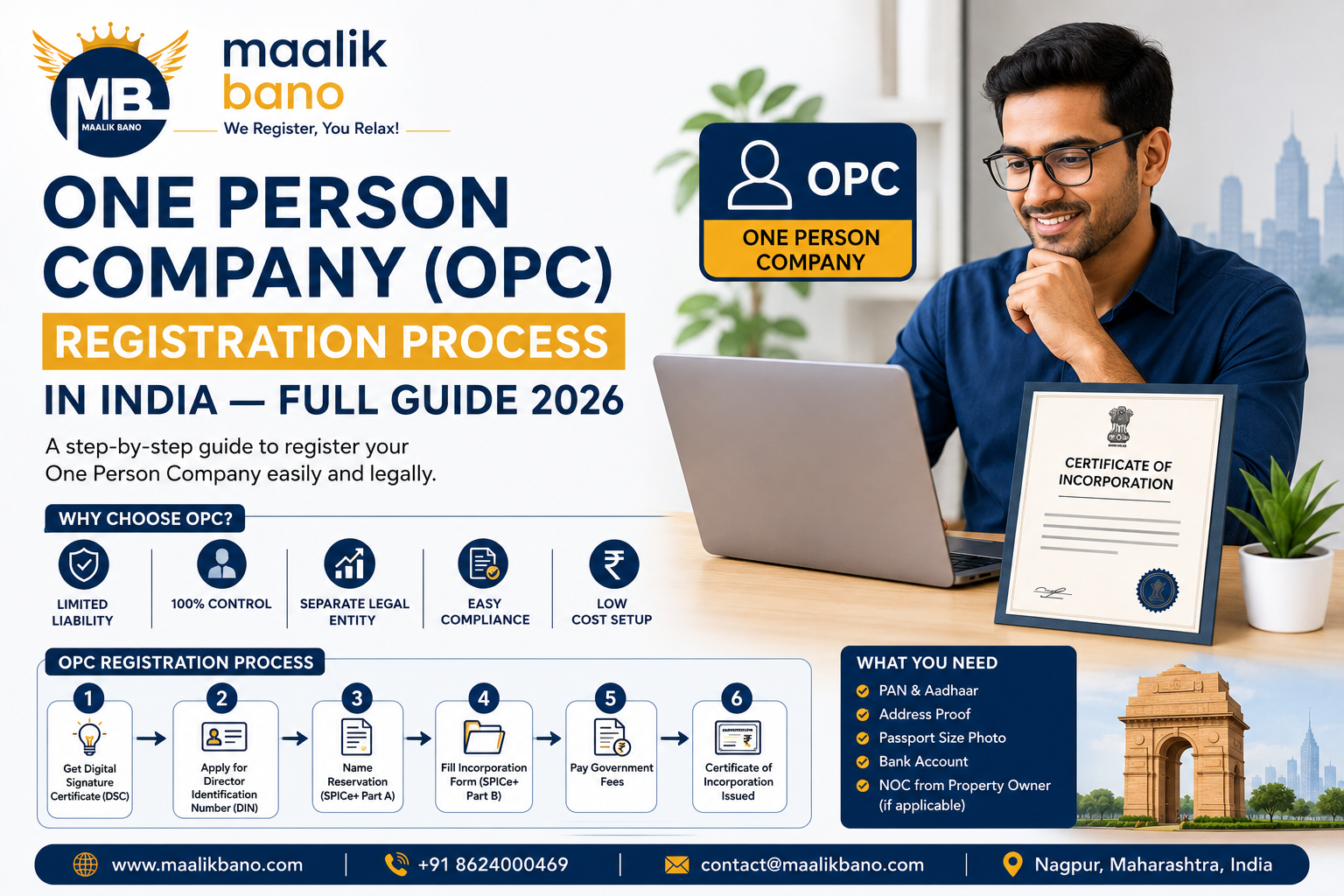
No. An LLP requires a minimum of 2 partners. If you want a single-founder structure with limited liability, consider a One Person Company (OPC) instead.
Can an NRI or foreigner be a partner in an Indian LLP?
Yes. However, at least one designated partner must be a resident of India (present in India for at least 182 days in the previous financial year). NRI partners need notarized and apostilled documents.
Is GST registration required at the time of LLP incorporation?
No, GST registration is not compulsory during incorporation. It becomes mandatory once your turnover crosses the prescribed threshold (₹40 lakh for goods, ₹20 lakh for services) or if you engage in interstate trade or e-commerce.
Can an LLP be converted to a Private Limited Company later?
Yes, under Section 366 of the Companies Act, 2013, an LLP can be converted into a Private Limited Company. This is a formal legal process involving MCA filings. If you think you may want to raise investment later, it is often better to start as a Pvt Ltd from the beginning to avoid restructuring costs.
What happens if Form 11 or Form 8 is not filed on time?
Late filing attracts an additional fee of ₹100 per day per form with no upper cap. Over time, this can result in heavy penalties and even strike-off of the LLP by the RoC.
Should You Start an LLP or a Private Limited Company?
If your business is a professional services firm such as accounting, consulting, architecture, IT services, or legal practice, and you have no immediate plans for external funding, an LLP is an excellent and cost-effective choice.
However, if you are building a product startup, planning to raise angel or venture capital, want to issue ESOPs to your team, or expecting rapid growth that will attract institutional investment, a Private Limited Company is the smarter long-term choice.
MaalikBano specialises in Private Limited Company registration across India. We have helped hundreds of founders register their Pvt Ltd companies fast, affordably, and with complete transparency with no hidden charges, no chasing for updates, and real-time status tracking through our dashboard.
Whether you are a first-time founder in Nagpur, Mumbai, Delhi, Pune, or anywhere in India, our expert team is ready to help.
Start your Private Limited Company registration today →
Final Thoughts
LLP registration in India has become faster and more streamlined than ever in 2026, thanks to the upgraded MCA V3 portal, integrated FiLLiP filing, and digital e-KYC. With the right documents in place, your LLP can be incorporated in under two weeks.
Here is a quick recap of the process:
- Obtain DSC for all designated partners
- Reserve your LLP name via RUN-LLP
- File the FiLLiP form on the MCA portal
- Receive your Certificate of Incorporation, LLPIN, PAN, and TAN
- Execute and file the LLP Agreement (Form 3) within 30 days
- Open a bank account and get GST registration if applicable
Stay compliant by filing Form 11 and Form 8 every year, and remember that an LLP with good standing is a credible, legally protected entity ready for growth.
Have questions about LLP registration or need help choosing between an LLP and a Private Limited Company? Reach out to the MaalikBano team at contact@maalikbano.com or call us at +91 8624000469.